
Dr Paul Mills writes from London, UK. He is an economist who specialises in government debt management and financial stability, and has worked for both the UK Treasury and the International Monetary Fund.
UK housing, relative to income, is the most expensive it has been for several generations. Near-zero interest rates (2008-21), money printing, strong net migration, the break-up of households, stagnant real wages, a favourable tax status and limited new supply have bid up average house prices to nine times average incomes — a level not seen since the 19th Century.
The average first-time buyer needed to devote 37% of their income to finance a mortgage in the first quarter of 2023 — the highest level since 2008, with further rises to come.[1] The despondency of the younger generation about their diminishing prospects of ever affording to buy a house prompts sporadic government initiatives to subsidise further first-time house purchase – thereby bidding up prices even more – and occasional, reckless mortgage innovations to enable buyers to borrow 100% of the house value once more.[2]
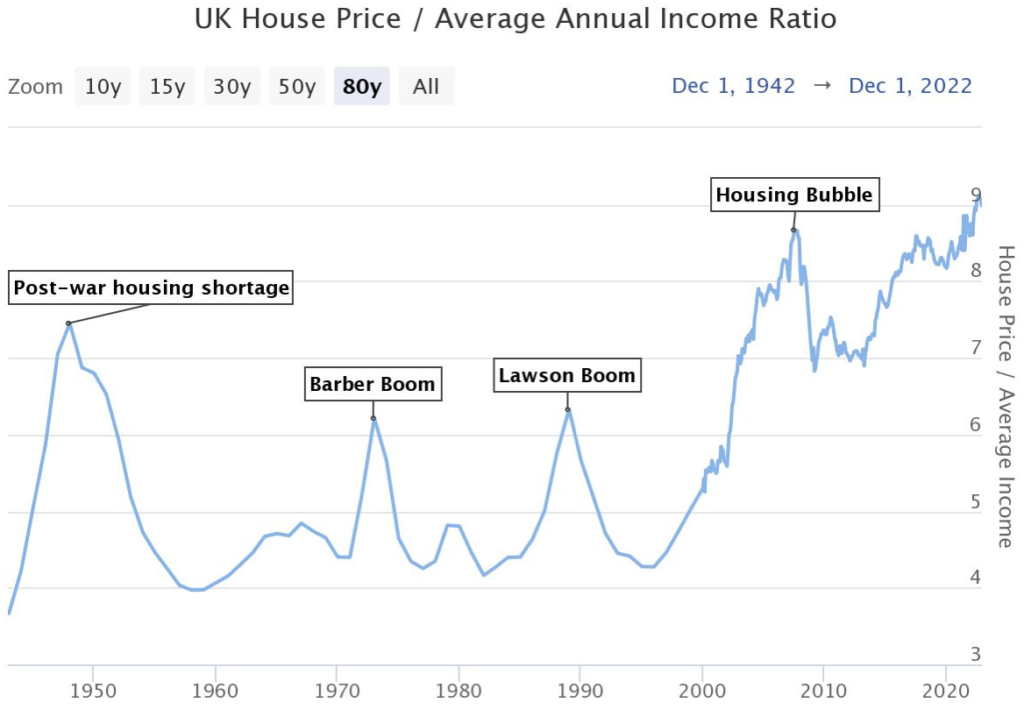
One of the causes of our housing affordability woes is the near-universal reliance on debt to finance house purchase. This results in house price booms and busts (see chart above) as easy loan conditions fuel a self-reinforcing boom which rapidly reverses when a recession or rising interest rates tighten lending standards and prompt foreclosures, which further force prices down. With prices elevated at present, buying a house is extremely difficult because one is committing to buy 100% of the house equity at the outset, making the debt service unaffordable. Is there a better way?
As it happens, there is — a relationally richer alternative. The ‘equity-share’ or ‘rent-to-buy’ contract does what the title suggests — that is, the house occupier and financier share the equity in the house, with the occupier renting the proportion of the house that they do not (yet) own. The relationship between the two parties is one of equity partnership in the property rather than debtor-creditor, resulting in a far richer flow of information and equitable sharing of risk.
A typical first-time buyer equity-share arrangement would entail the purchaser putting down 5 or 10% of the value (x) with the financier contributing 90 to 95% (100-x). Rent would be charged at a pre-agreed rate on (100-x), with future rents linked to a local or regional rental index. Maintenance and insurance costs would be shared on a basis proportionate to ownership shares. The parties then agree the extent and timescale for the purchase of the house’s equity as the occupier pays a monthly amount above their rental obligation. As they do so, x% rises over time and (100-x)% declines. Indeed, payments could be structured such that, after 25-30 years the occupier would acquire the whole property on a schedule comparable to a mortgage.
But the equity-share partnership approach offers much more flexibility and protection for the occupier when things go wrong. First, the share of the home equity that the occupier wishes to acquire need not be 100%. They could reduce their monthly payments by planning to buy less of the equity over time. Second, flexibility could be specified in the contract that allowed the occupier to pause payments if a crisis hits that disrupts household income, such as illness or unemployment. They would then cease to acquire more equity in the house and might even begin to exchange their equity for rental payment delays on a pre-agreed basis.
The benefits for the wider economy and financial system would be significant. Not only would this contract help to dampen the speculative boom and bust in housing that comes from its debt-based financing but it provides a way for those with long-term savings to invest in housing without the need to buy a house of their own. At present, there are few means whereby younger savers can invest in an asset that provides housing returns. If current mortgage lenders pooled savings for financing these equity shares, then they could offer returns linked to house rents and prices. Indeed, this could be the basis for pooled investment funds to own a portfolio of housing shares in a particular region or nationally, offering pension funds a long-term residential property investment that they currently lack.
What holds back this contract now? Primarily the inertia of current debt-based practices and the relative contractual simplicity of the mortgage. Banks and building societies are also penalised heavily by regulators for owning shares outright in property as opposed to holding a mortgage on the very same property. Also, when house prices are rising, buyers are reluctant not to try to acquire 100% of the equity through a debt-financed purchase. But with prices now stable or falling, the opportunity arises for an equity-sharing contract to help younger buyers begin to own a flexible share of a house. It is time for a relational solution to the housing crisis.
Comments and discussion are welcome (see below). Please note that comments will be moderated to avoid trolling and spamming, and so will not appear immediately.
References
| ↑1 | Source: Nationwide Building Society; https://www.nationwidehousepriceindex.co.uk/resources/ftb-mtg-payments-by-region |
|---|---|
| ↑2 | https://www.theguardian.com/money/2023/may/08/uk-mortgage-lender-100-loans-skipton-building-society |