
Paul Shepanski writes from Sydney, Australia. He serves as Executive Director of Relationships Forum Australia and is the director of an online travel agency.
Back in March 2020, as the world was coming to terms with the implications of the new virus, people here in Australia responded in some unexpected ways. Toilet paper disappeared rapidly from supermarket shelves. Crowds flocked to Bondi Beach in contravention of clear public health orders. And at the same time, there was a growing call for all of us to exercise social responsibility; the easiest way to save lives, we were told, was simply to stay at home. Last year, the Victorian State Government went so far as to introduce the Orwellian slogan: ‘Staying apart keeps us together’.
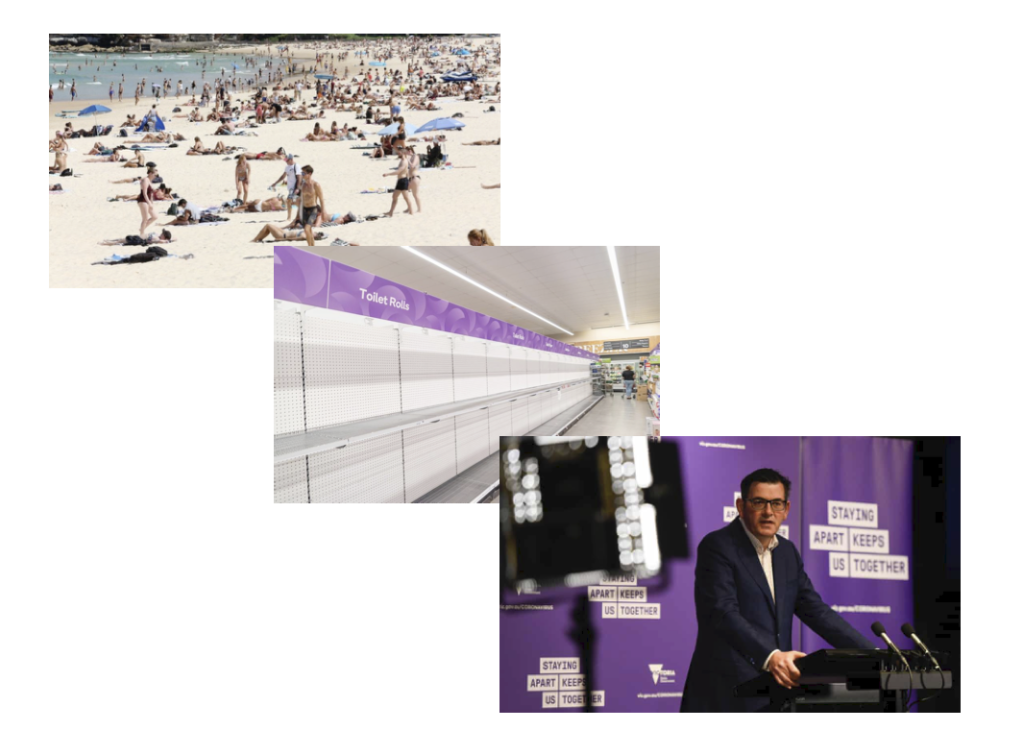
These reactions typify three possible biases in our responses to the pandemic, shown here in a matrix:

The way we respond in this and any crisis can be tracked along two dimensions:
- Are we focused on what’s good for ourselves or on what’s best for others? (the horizontal axis)
- Are our actions driven by fear or by hope? (the vertical axis)
Generally speaking, hoarding toilet paper is a response where individuals, driven by fear, place their needs above those of others in the community.
Large numbers of carefree beachgoers demonstrate hope, even if misplaced, that they will be unaffected by the virus while showing little concern for the impact of their actions on others.
At the other extreme, those who would do anything (including doing nothing at home) to avoid spreading the disease do so out of fear for the safety of others.
More broadly, the two primary, opposing responses to the pandemic we’ve seen over the last two years reflect these same intrinsic motivations and biases. Those who favour lockdowns and mandatory vaccinations emphasise our shared responsibility for one another’s well being (the lower right box). Those who argue against various forms of restrictions and mandates declare we shouldn’t continue to live under a regime dominated by fear drummed up by self-interested parties in the media and government (the upper left box).
While it’s difficult to find someone who can offer a well reasoned, moral argument for the hoarding of toilet paper, proponents on both sides of the lockdown/vaccination debate cite inherently relational principles to support their views.
Naturally, those in favour of government restrictions and mandates say their concern is for the good of others, particularly those most vulnerable. They warn of overstretched hospitals and spiralling mortality rates.
Those on the other side point to the negative impacts of social isolation, business failures and other relational ills resulting from the same government policies, again particularly as they affect the weakest members of society.[1]
Clearly both approaches carry significant risk. Which leaves us with the question mark in the top-right box in our matrix. Are there responses to the pandemic that are unambiguously outward looking: focused both on the wellbeing of others and that look forward hopefully to the maintenance and strengthening of relationships? This will be the subject of a follow-up post.
Comments and discussion are welcome (see below). Please note that comments will be moderated to avoid trolling and spamming, and so will not appear immediately.
References
| ↑1 | In The Relational Dimension of the Lockdown Disaster, Paul Mills points out that these negative effects are generally not well measured nor have they been considered with any real weight in government decision making. He argues implicitly, therefore, that an anti-lockdown stance does not necessarily stem from narrow self-interest. |
|---|